Refurbished CT Scanner Buying Guide: 9 Checks Before You Buy
A new CT scanner can easily cost more than $1 million. For hospitals, imaging centers and growing outpatient clinics, a refurbished CT scanner can deliver the image quality referring physicians expect for a fraction of that price. But those savings only hold up if you buy the right system in the right condition and install and support it properly.
Our field engineers inspect, de-install and ship pre-owned CT systems for healthcare facilities around the world. This guide walks through the nine checks we make before recommending a system, plus the questions you should ask any vendor before you sign.
Is a Refurbished CT Scanner the Right Choice?
Buying pre-owned makes the most sense when you need proven diagnostic performance without the capital outlay of a brand-new system. Common scenarios include:
- Replacing an aging scanner that’s becoming expensive to keep running
- Adding a second CT to cut wait times or support a busy emergency department
- Opening a new imaging center or outpatient clinic on a startup budget
- Rural and critical-access hospitals that need reliable in-house CT
- Bridging a budget cycle until a larger capital project is approved
One distinction matters before you compare quotes: used and refurbished are not the same thing. A “used” CT may be sold as-is, straight out of the room it came from. A properly refurbished CT scanner should be inspected, tested, repaired, cleaned, updated where possible, and installed with a warranty. Always ask a vendor to spell out exactly what their refurbishment includes.
How Much Does a Refurbished CT Scanner Cost?
Price depends mostly on slice count, manufacturer, model year, software level and tube condition. Based on published 2026 industry pricing guides, typical market ranges look roughly like this:
| Slice count | Typical clinical use | Approx. refurbished price range* |
|---|---|---|
| 16-slice | General diagnostic imaging: head, chest, abdomen, trauma | $80,000 – $180,000 |
| 32/40-slice | Higher-volume general imaging, routine angiography | $120,000 – $250,000 |
| 64-slice | Cardiac CTA, advanced angiography, high throughput | $175,000 – $375,000 |
| 128-slice and up | Advanced cardiac, perfusion, specialty programs | Quote-based; varies widely by model |
*Market estimates for the equipment only, not a quote. Actual pricing depends on the specific system and configuration.
The purchase price is only part of the budget. Plan separately for shipping and rigging, installation, room construction and radiation shielding, electrical and HVAC upgrades, physicist testing, staff training and an ongoing service agreement. Over the life of the system, CT tube replacement is often the largest single expense. A new tube can run well into six figures depending on the model, which is why the tube’s history matters so much (see check #2).
9 Things to Check Before You Buy a Refurbished CT Scanner
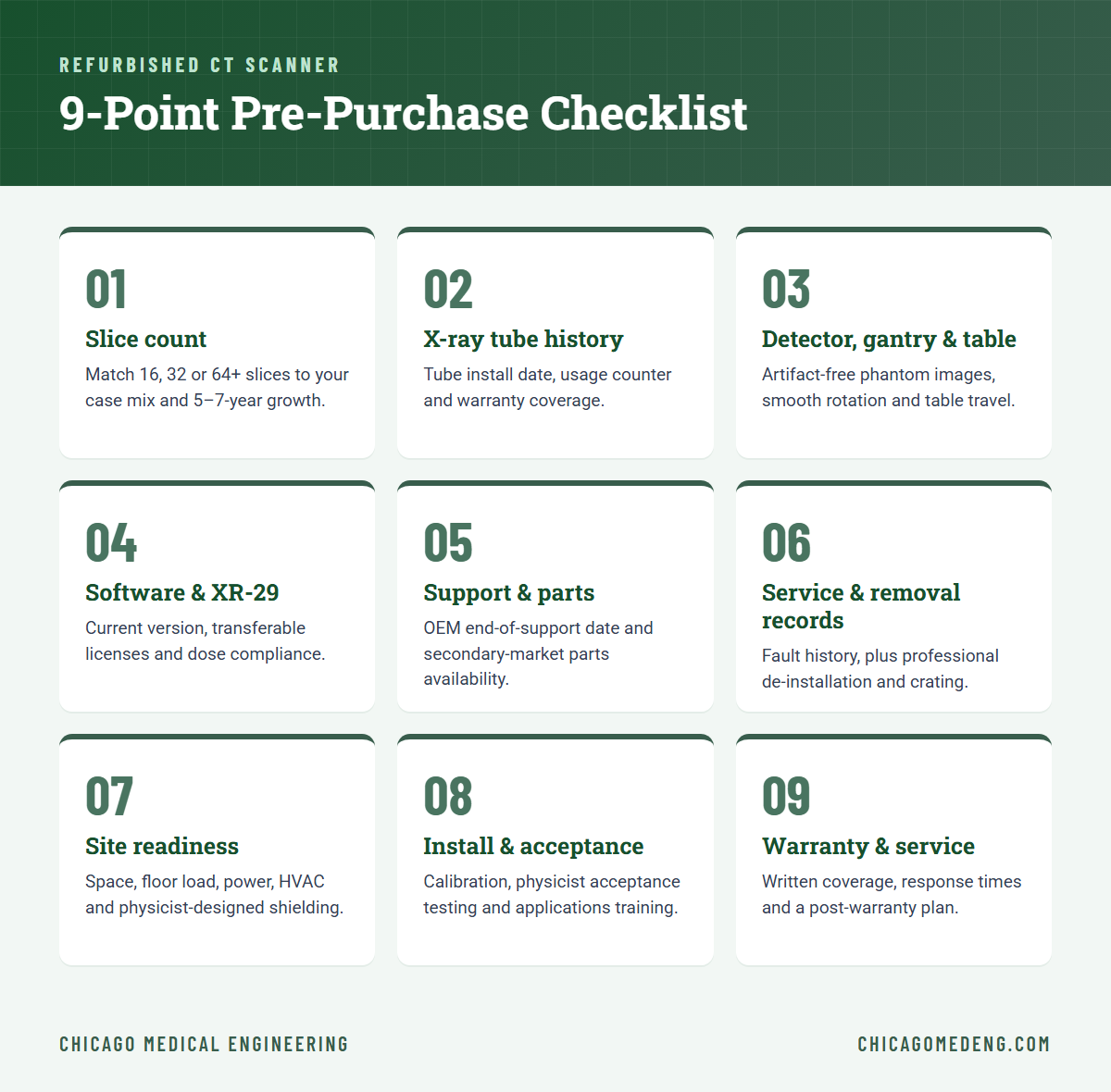
1. Match the Slice Count to Your Clinical Mix
More slices mean faster coverage, thinner images and cardiac capability, but also a higher price and more expensive parts. If your volume is mostly routine head, chest, abdomen and trauma work, a well-maintained 16- or 32-slice system is often enough. Cardiac CTA programs and high-volume emergency departments usually justify a 64-slice CT scanner or higher.
Buy for where your referral patterns will be in five to seven years, not just where they are today.
2. Review the X-Ray Tube’s History
The X-ray tube is the component that wears out, so it should be one of the first things you ask about. Request:
- The install date of the current tube
- The tube’s usage counter (scan seconds or mAs, depending on the manufacturer)
- Whether the tube is original or has been replaced
- Whether the tube is covered by the warranty, and for how long
A system with a fresh tube is often better value than a cheaper system whose tube is close to the end of its life.
3. Inspect the Detector, Gantry and Table
Ask for recent phantom images from the system. They should be free of ring artifacts, streaks and banding that can point to detector problems. Listen for unusual noise during gantry rotation, which can indicate bearing or slip-ring wear. Check that the patient table moves smoothly and accurately and that its weight limit suits your patient population, including bariatric patients.
Ideally, see the system scanning before it’s de-installed, or ask for video of it running.
4. Confirm Software, Licenses and XR-29 Dose Compliance
The software version determines which protocols, reconstruction methods and dose-reduction tools you get. Confirm which clinical application licenses come with the system (cardiac, perfusion and others) and whether they transfer to you. Some licenses stay with the original owner.
Just as important is compliance with the NEMA XR-29 “Smart Dose” standard. Under the Protecting Access to Medicare Act, CMS reduces the technical component payment for outpatient CT exams performed on non-compliant scanners by 15%. On a busy scanner, that cut can wipe out your savings quickly.
5. Check OEM End-of-Support and Parts Availability
Every model eventually reaches the manufacturer’s end-of-support date. An older system isn’t automatically a bad buy, as long as parts are plentiful and experienced independent engineers know it well. Ask:
- When does (or did) OEM support end for this model?
- Are replacement parts readily available on the secondary market?
- Can the vendor supply medical parts and service the system after installation?
6. Ask for Service Records and How It Was De-Installed
Service logs show recurring faults and how well the system was maintained. Just as important is how the scanner was removed. A CT de-installed by an untrained crew, with cut cables, poor labeling or no proper crating, can arrive with damage you won’t find until installation day.
Ask who de-installed the system, how it was packed and how it was shipped. (For a look at what professional de-installation involves, see our Varian TrueBeam LINAC de-installation project.)
7. Make Sure Your Site Is Ready
Site preparation is where many CT projects fall behind schedule. Get the system’s site-planning specifications early and check:
- Room dimensions, ceiling height and floor loading
- Dedicated electrical power and, where needed, a UPS
- HVAC capacity for the gantry and equipment room heat load
- Radiation shielding designed by a qualified medical physicist
- State registration requirements for the new X-ray-producing equipment
If you’re building or renovating a room, a turnkey project partner can coordinate site planning, delivery and installation so nothing falls through the cracks.
8. Plan Installation, Acceptance Testing and Training
A proper installation includes calibration and full system testing, followed by acceptance testing by a qualified medical physicist. Many states require this, and it’s needed if you plan to pursue ACR CT accreditation. Your technologists should also receive applications training on the system’s protocols and workflow.
Confirm in writing whether installation, calibration and training are included in your quote.
9. Get the Warranty and Service Plan in Writing
Know exactly what the warranty covers (tube, detector, parts, labor, travel), how long it lasts and what response times you can expect. Just as important, line up your post-warranty service before you buy, whether that’s a full service contract or time-and-materials support. Downtime on a CT scanner means lost revenue and delayed patient care.
Learn more about our medical equipment service and maintenance options.
Questions to Ask Any Refurbished CT Scanner Vendor
Copy this list into your next vendor call:
- What exactly does your refurbishment process include?
- How old is the X-ray tube, what does its usage counter show, and is it under warranty?
- Can I see recent phantom images or video of the system scanning?
- Which software version and application licenses are included, and do the licenses transfer?
- Is the system NEMA XR-29 compliant?
- Who de-installed the system, and how was it crated and shipped?
- Are installation, calibration, physicist support and applications training included?
- What does the warranty cover, and what service options are available afterward?
Financing a Refurbished CT Scanner
A refurbished system already lowers your capital requirement, but you don’t have to pay for it all upfront. Capital medical equipment leasing lets you spread the cost over time and preserve cash for staffing and site preparation.
If you’re replacing an older scanner, selling it can offset part of the new system’s cost. Our guide on how to sell used medical imaging equipment explains how to get the most value from it.
Buying a Refurbished CT Scanner from Chicago Medical Engineering
Chicago Medical Engineering was founded in 2019 by a team of engineers. Today we bring more than 80 years of combined experience to pre-owned imaging equipment sales, service and installation. Based in Elmhurst, Illinois, we supply CT systems from leading manufacturers including GE, Siemens, Philips, Canon (Toshiba) and Hitachi to facilities worldwide.
When you buy a CT scanner from CME, you get:
- Engineer-led inspection: every system is inspected, de-installed and shipped by our own engineers
- Refurbishment options to bring your scanner to like-new condition
- Crating, worldwide shipping and installation, with project management from start to finish
- Staff training on operating and maintaining your system
- Removal or relocation of your existing CT scanner
- Flexible warranty, service and maintenance options after installation
Browse our CT scanner inventory or contact our team to talk through your clinical needs, site and budget.
Frequently Asked Questions
How much does a refurbished CT scanner cost?
Most refurbished 16- to 64-slice CT scanners fall between roughly $80,000 and $375,000 for the equipment alone, depending on slice count, manufacturer, model year, software and tube condition. Budget separately for installation, site preparation, shielding, training and service.
How long does a refurbished CT scanner last?
With regular preventive maintenance, CT systems are commonly budgeted for a 7- to 10-year lifecycle. Expect to replace the X-ray tube at least once during that time, depending on your scan volume.
Is a refurbished CT scanner as good as a new one?
A properly refurbished system can deliver image quality comparable to the same model when it was new. What you give up is access to the very latest hardware and software features, which many clinical programs don’t need.
What’s the difference between a used and a refurbished CT scanner?
A used CT scanner may be sold as-is, with no testing or warranty. A refurbished CT scanner has been inspected, tested, repaired and cleaned, and is typically installed and calibrated with a warranty.