How to Sell Used Medical Imaging Equipment: A 5-Step Guide for Hospitals and Imaging Centers
When a new system arrives, the old one doesn’t have to become a sunk cost. A working CT scanner, MRI, cath lab or X-ray system that no longer fits your department can still have real resale value, and selling it can help pay for its replacement.
How much you recover depends heavily on timing and preparation. This guide covers when to sell, which selling options you have, what drives value, and the five steps to sell used medical imaging equipment safely and compliantly, plus the common mistakes that quietly lower what your system is worth.
When Should You Sell Your Imaging Equipment?
Facilities usually start looking for a buyer when they are:
- Upgrading to a newer system or higher field strength
- Consolidating services after a merger or acquisition
- Closing or relocating a site or department
- Underusing a modality that no longer earns its floor space
- Facing rising service costs or the manufacturer’s end-of-support date
The best time to sell is while the system is still installed, running and under service. A scanner a buyer can see working, with a documented service history, is worth more than one that has sat powered down in a storage room for six months.
Your Options: Trade-In, Sell Direct, Consign or Dispose
| Option | How it works | Best for | Watch out for |
|---|---|---|---|
| OEM trade-in | Credit toward a new system from the same manufacturer | Convenience when you’re already buying new | Credit is often below market value and tied to that purchase |
| Sell to a direct buyer | A refurbisher buys the system outright and handles removal | Working systems; predictable timelines | Confirm who performs de-installation and who carries liability |
| Broker or consignment | A third party markets your system for a commission | Specialized systems when you have time to wait | Longer timelines; the system must stay available |
| Part-out | Components are sold individually | Non-working or end-of-life systems | Lower total return |
| Removal and disposal | Equipment is removed and responsibly disposed of | Systems with no resale value | You pay for removal; data and radiation rules still apply |
For most working CT, MRI and X-ray systems, selling directly to an experienced buyer that also handles de-installation is the simplest path. You deal with one party, one timeline and one set of engineers in your building.
What Determines the Value of Used Imaging Equipment?
No two systems are priced the same. Buyers look at:
- Modality and market demand: some systems are in higher demand than others at any given time
- Manufacturer and model: popular platforms with good parts availability resell more easily
- Manufacture date and software version: newer software and remaining OEM support add value
- Condition and service history: complete, consistent service records build buyer confidence
- Key component health: CT tube usage, MRI helium level and cryogen system condition, and detector condition all affect price
- Included accessories: MRI coils, injectors, workstations, phantoms, manuals and service keys
- Operational status: a system that’s still installed and scanning is worth more than one that’s been shut down
- Removal access: a ground-floor room with a clear path to the loading dock is easier and cheaper to remove than an upper-floor suite
How to Sell Used Medical Imaging Equipment in 5 Steps
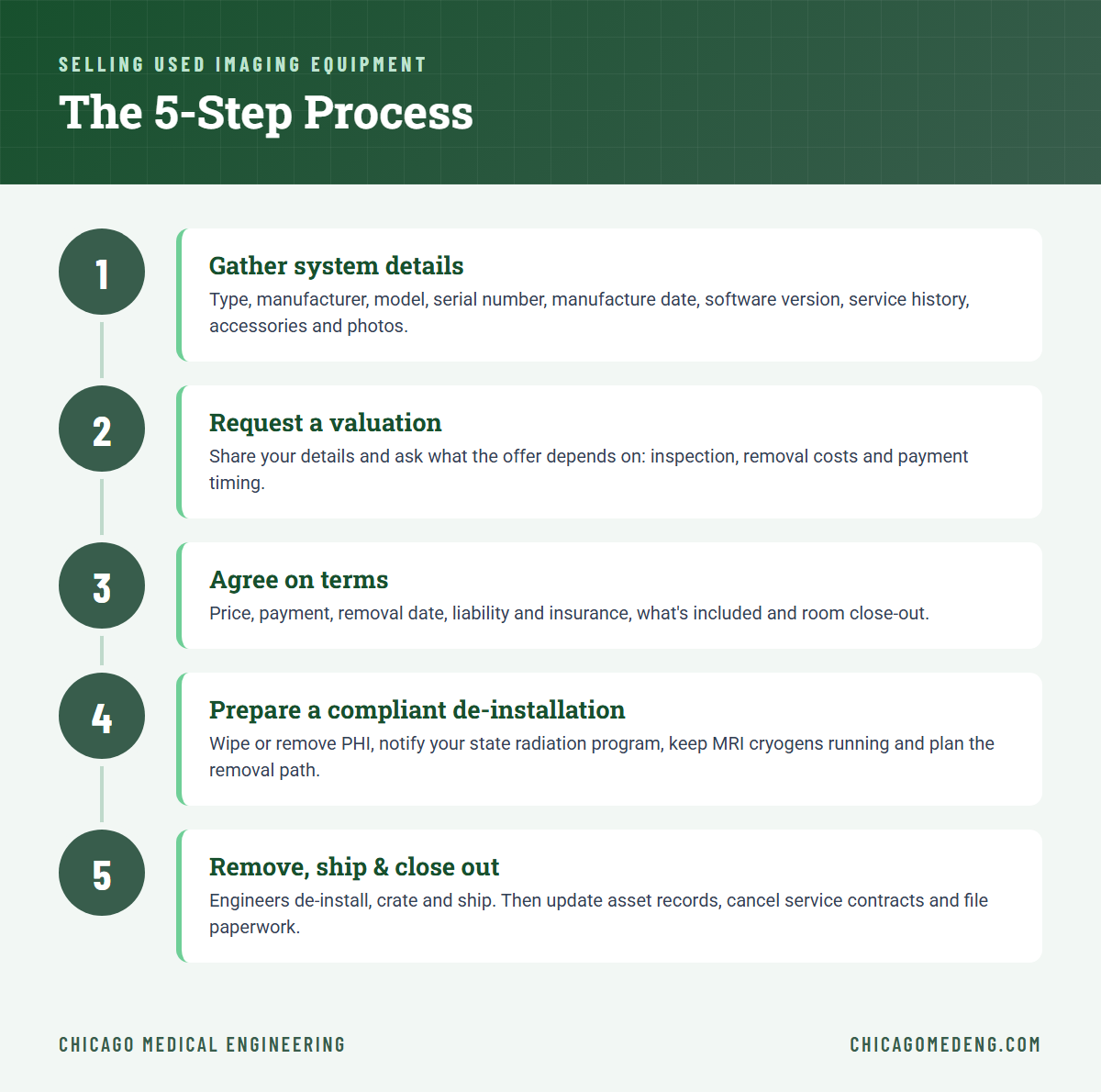
Step 1: Gather Your System Details
A buyer can give you an accurate valuation much faster when you have the details ready. Pull together:
- Equipment type and manufacturer
- Model number and serial number
- Date of manufacture and current software version
- Date of last service and your service contract number
- Any known issues or error history
- A list of included accessories (coils, injectors, workstations, phantoms)
- Photos of the gantry or magnet, console, equipment cabinets, the serial number label and the removal path out of the room
Step 2: Request a Valuation
Share your system details with your buyer and ask for a valuation. Before comparing offers, find out:
- Is the offer subject to an on-site inspection or demonstration?
- Who pays for de-installation, rigging and shipping?
- When and how is payment made?
- How long is the offer valid?
An offer that looks higher on paper can come out lower once removal costs are taken off.
Step 3: Choose Your Buyer and Agree on Terms
Once you pick a buyer, get the terms in writing, including:
- Sale price and payment terms
- Target removal date and working hours (for example, after hours to avoid disrupting patients)
- Who performs the de-installation, and proof of insurance
- The condition the system will be in at pickup
- Exactly what’s included in the sale
- Who handles room close-out, such as safely terminating power and disconnecting chilled-water lines
Step 4: Prepare for a Safe, Compliant De-Installation
This is the step that protects your facility, your patients and your system’s value.
Protect patient data. CT and MRI consoles, reconstruction computers and workstations store images that contain protected health information. The HIPAA Security Rule requires covered entities to remove electronic PHI from hardware and media before disposal or reuse. Have drives cleared, purged or removed, and keep documentation of the data destruction.
Notify regulators. CT scanners, X-ray systems and linear accelerators are registered radiation-producing equipment. Many states require you to update your registration or notify the state radiation control program when equipment is sold, transferred or removed. Check your state’s requirements before removal day.
Protect the MRI magnet. Keep the cryogen system powered and the coldhead running until the buyer’s engineers arrive. An MRI magnet must be ramped down by trained engineers, and a magnet that loses its helium or is quenched can lose significant value.
Plan for special cases. Linear accelerators require a radiation survey before removal, and high-energy units may have components that need special handling.
Coordinate with facilities. Confirm the removal path, elevator and floor load limits, loading dock access, and floor and wall protection. Also plan for any construction needed to get large components out, such as removing a wall panel or window.
Complex removals take specialized rigging and experience. See our Varian TrueBeam LINAC de-installation for a behind-the-scenes look at one.
Step 5: Remove, Ship and Close Out Your Records
Engineers de-install, label, crate and rig the system out of your facility for shipping. Once it’s gone, finish the administrative side:
- Update your fixed-asset register
- Cancel service contracts, software subscriptions and remote-monitoring connections
- File any required state radiation registration paperwork
- Keep the bill of sale and data-destruction documentation with your records
Common Mistakes That Lower Your Resale Value
- Cancelling service or powering down too early. A system that can’t be demonstrated is harder to value and sell.
- Letting an MRI lose helium. Refilling cryogens is costly, and buyers will price that in.
- Losing documentation. Missing service history, manuals, service keys, passwords or license information all reduce value.
- Waiting until the last minute. A rushed removal before construction starts limits your buyers and your negotiating power.
- Using untrained crews. Cut cables, unlabeled parts and poor crating can damage the equipment you’re trying to sell.
- Splitting up accessories. Coils, injectors and phantoms are worth more sold with the system.
Sell Your Imaging Equipment to Chicago Medical Engineering
Chicago Medical Engineering buys pre-owned imaging equipment from hospitals, imaging centers and radiation therapy centers, including CT scanners, MRI systems, cath labs, X-ray, ultrasound, linear accelerators and bone densitometers, as well as medical parts and MRI coils.
Founded in 2019 by a team of engineers, CME brings more than 80 years of combined experience to imaging equipment service, installation and de-installation. Every system we handle is inspected, de-installed and shipped by our own engineers, not outside crews.
If you’re replacing the system you’re selling, we can help on that side too, with pre-owned imaging equipment, capital equipment leasing and turnkey installation. Shopping for a replacement CT? Start with our refurbished CT scanner buying guide.
Ready to sell? Complete our equipment sell form with your system details, or call us at +1 (331) 332-0001.
Frequently Asked Questions
Who buys used medical imaging equipment?
Used imaging equipment is typically bought by refurbishers and resellers, brokers, parts suppliers and OEMs (through trade-in programs). Refurbishers that buy directly usually handle de-installation and resell the system to hospitals and imaging centers.
How much is my used CT scanner or MRI worth?
Value depends on the modality, manufacturer, model, manufacture date, software version, condition, service history and current market demand. The fastest way to find out is to share your system details, including model, serial number and service history, with a buyer for a valuation.
Do I need to de-install my equipment before selling it?
No. It’s usually better to leave the system installed and running so it can be inspected or demonstrated. An experienced buyer will handle de-installation, crating and shipping.
Can I sell imaging equipment that isn’t working?
Often, yes. Non-working systems can still have value for parts. Be upfront about known issues so the buyer can give you an accurate offer.
What happens to the patient data on my equipment?
Before equipment leaves your facility, hard drives containing patient images must be wiped or removed so the protected health information can’t be read, as HIPAA requires. Keep documentation of the data destruction for your records.